

Two friends, born at the same clock time — completely different Bazi charts.
One friend is born in Beijing, with the clock at 8:00 AM. Another is born in New York, also at 8:00 AM. Two clocks read the same — but the sun is in completely different positions in the two skies. In Beijing the sun has already climbed into the southeast; in New York it's still below the horizon, hours from rising.
Bazi reads the sun, not the clock.
This article covers two things: first, why clock time and true solar time aren't the same thing; second, why AstroBazi defaults to true solar time when you open the calculator — so all you have to do is enter your birth city.
1. Clock time is political; the sun doesn't care about borders
The same number on two clocks is doing two different jobs.
One is clock time. The "9:15 AM" on your phone is a 19th-century invention — railroad engineers carved each country into a few wide time zones so trains wouldn't crash. It's a useful fiction. Convenient for life. Not astronomical.
The other is solar time. Long before clocks, people read the shadow on a sundial — the sun's actual position in the sky. That's not a fiction. That's an astronomical fact, indifferent to political borders.
Most of the time, the two line up. But when you're born far from your time zone's central meridian, the gap opens.
The most dramatic comparison is China vs. the United States:
- China spans 60° of longitude — but the entire country runs on Beijing time, a single zone. At noon on the Beijing clock, the sun is overhead in Beijing but still in the southeast over Kashgar — about 80 minutes from its zenith
- The United States is roughly the same width — but uses four time zones, so within any one zone, solar drift is at most ~30 minutes
Clock time was drawn by governments. The sun doesn't care about borders.
The theory is here. Your personal chart is one step away.
Calculate My Free Chart →2. The Hour Pillar tracks the sun, not the watch
Bazi — rooted in 3,000 years of Chinese tradition — splits your moment of birth into four pillars: year, month, day, and hour. The Hour Pillar has never been about "the number on the clock." It's about the sun's actual position in the sky at that moment.
The ancient Chinese divided a day into 12 shichen — two-hour blocks named after the Earthly Branches: zi, chou, yin, mao… all the way to hai. Each shichen corresponds to a specific position of the sun: below the horizon, rising, crossing the meridian, descending. A few minutes near a shichen boundary can push you into the next one — and your Hour Pillar's stem and branch change entirely. (See our companion article: The 12 Chinese Shichen — Complete Hour-by-Hour Chart.)
That's why true solar time matters specifically for Bazi: it corrects exactly the gap between the number on the clock and where the sun actually was.
What our tool calculates for you, behind the scenes:
- Longitude correction: how far your birthplace sits from your time zone's central meridian — 4 minutes per degree of offset
- Equation of time: Earth's orbit is elliptical, not circular, which shifts solar time by up to ±16 minutes across the year
You don't need to understand these formulas. You just tell us your birth city.
3. A note: why "birthplace" true solar time, not a fixed reference?
There's a long-running debate in Chinese metaphysics: should true solar time be calculated for the birthplace itself, or relative to a fixed reference point (typically Beijing 116°E or the time-zone center 120°E)?
We chose the first — birthplace true solar time. Three reasons:
- The literal meaning of "true" — true solar time means "the sun's actual position at that moment." If you were born in Paris, the sun was over Paris that moment, not over Beijing
- Bazi reads your relationship to that moment of the cosmos — the Hour Pillar records how the sun was hitting you. Borrowing someone else's sky borrows someone else's moment
- The method, not the place — what we inherit from ancient practitioners is the practice of reading the sun. They happened to read it in China. For a global audience, honoring the method (not the geography) is closer to the spirit of the tradition
This is a choice, not a verdict. If your teacher's lineage uses a fixed reference, that's also reasonable — but by default, we use your birthplace.
Want to try the fixed-reference method? You can: convert your birth time to Beijing time (UTC+8) first, then select Beijing in the city picker. The tool will calculate using Beijing's longitude (116°E) and Beijing's time zone — the equivalent of the fixed-reference method.
4. All you have to do is pick a city
Open the calculator and enter your birth city.
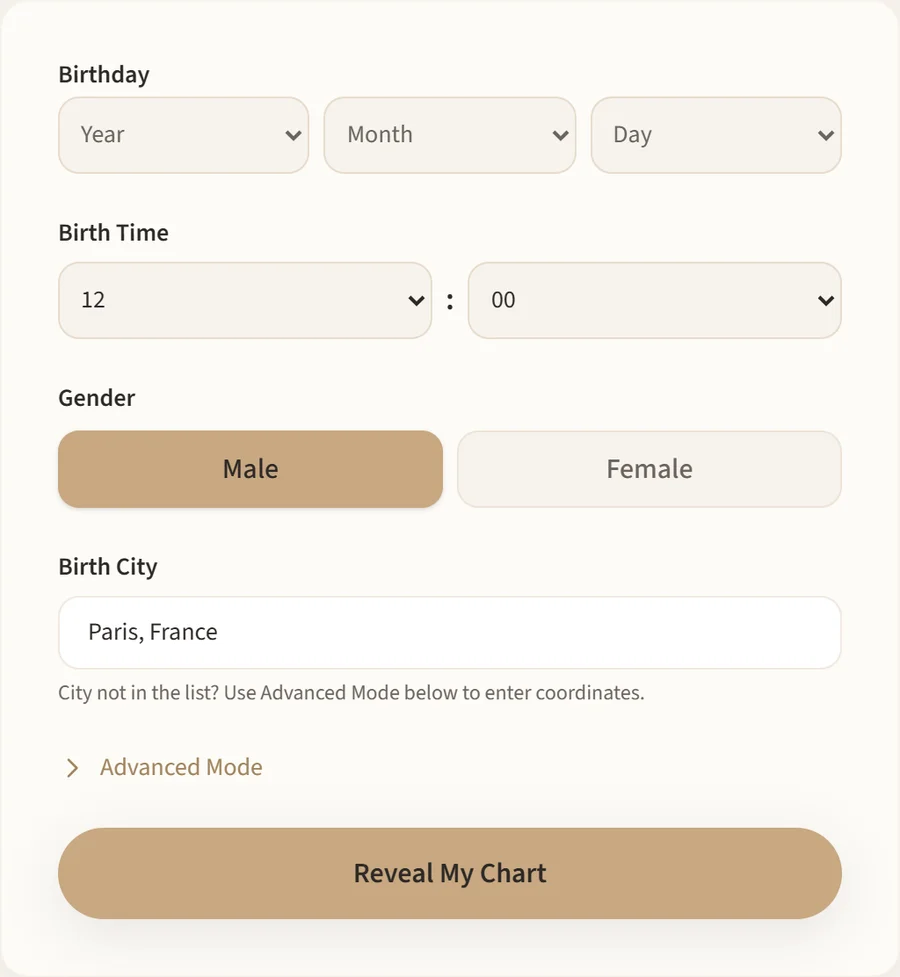
We support most major cities worldwide. If your city is in our database, suggestions appear in the dropdown; if it's smaller, our global geocoding service fills the gap automatically — you can still pick it.
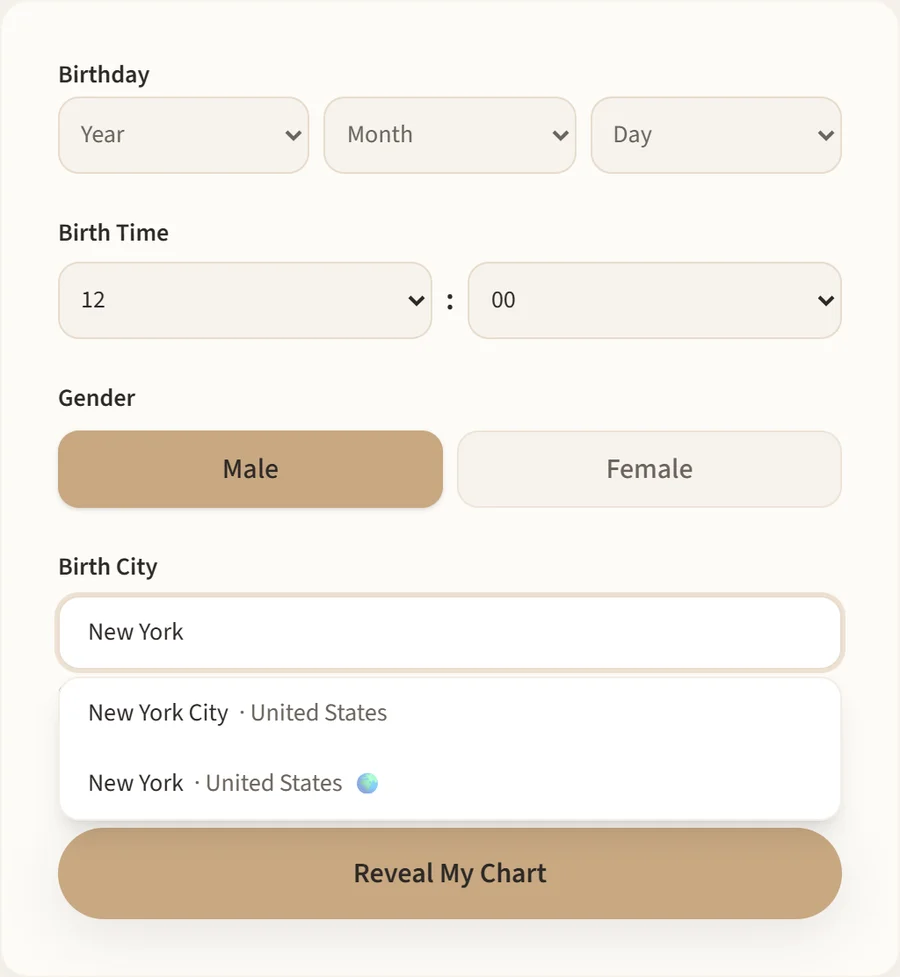
That's it. The moment you select a location, the calculation behind the scenes runs on true solar time — no checkbox, no second decision asked of you.
Our judgment: a correct default is more valuable than a checkbox that asks the user to make a call.
5. When you might use Advanced Mode
Most users never need to. It exists for two edge cases:
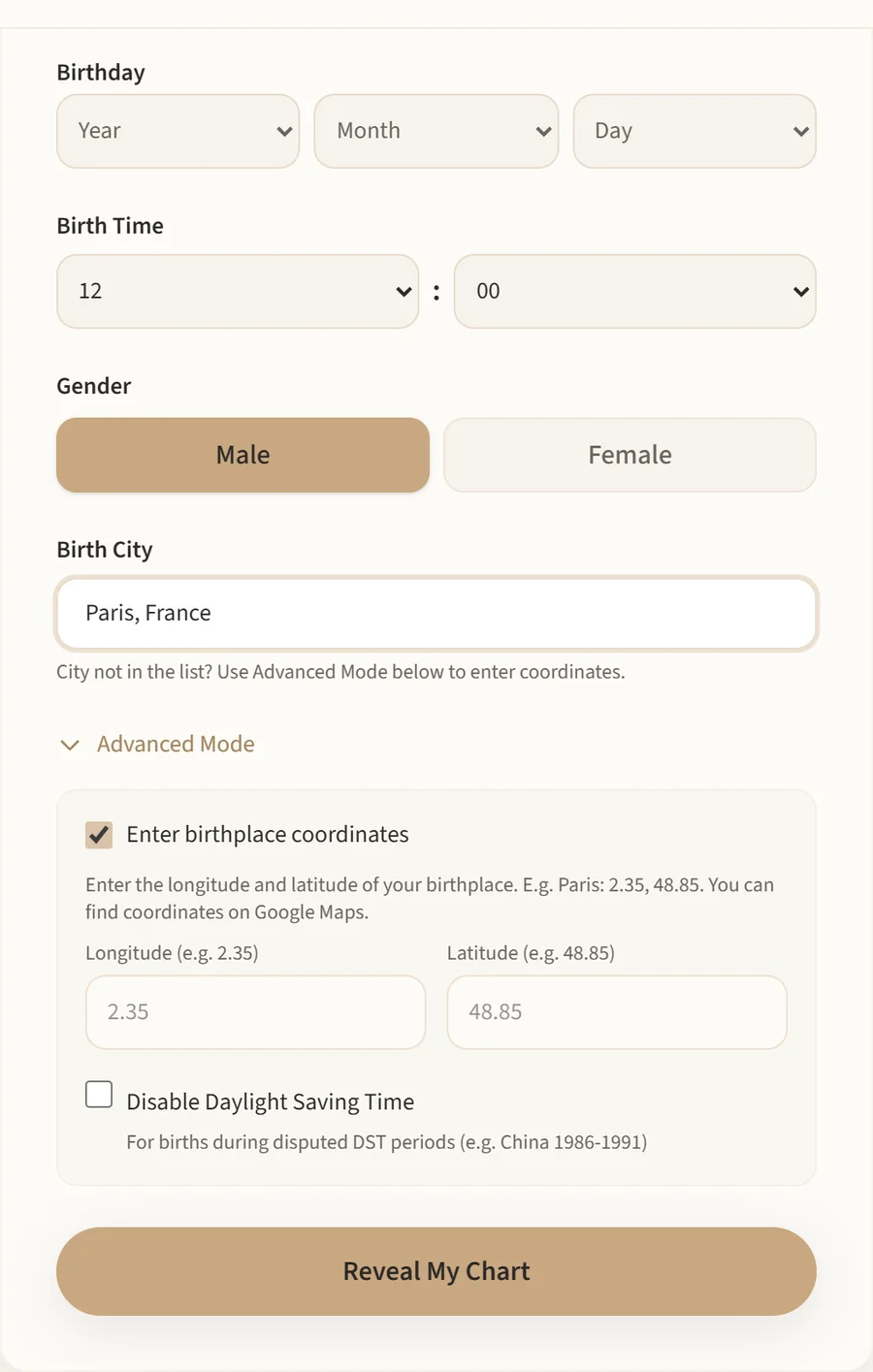
A. Your birthplace isn't in our database or our global geocoding service
Some hamlets or historical place names. In that case, fill in longitude and latitude manually — search "[city name] coordinates" on your phone and paste them in.
B. You want absolute precision
Cities default to city-center coordinates — usually within a few minutes of any specific address. If you know the exact birth hospital or home address, manual coordinates can shave off a bit more error. Honest answer: the difference rarely changes your Hour Pillar.
AstroBazi automatically handles known historical DST periods (China 1986–1991, Brazil's various DST years, the annual US/EU shifts, and others). If you have specific knowledge that your recorded birth time was logged in standard time despite falling within a DST window, you can disable the adjustment in Advanced Mode.
Closing
Bazi is a Chinese language carrying 3,000 years of wisdom. Our job is to make sure the "time" you're reading really is the time the sun was telling at that moment.
You enter the city. We handle the rest.
If you don't know your exact hour of birth, take heart — Bazi's real backbone is the Day and Month Pillars. Want to learn what your Day Master is and what it means? See What's Your Day Master? Bazi's 10 Personality Types, Explained.